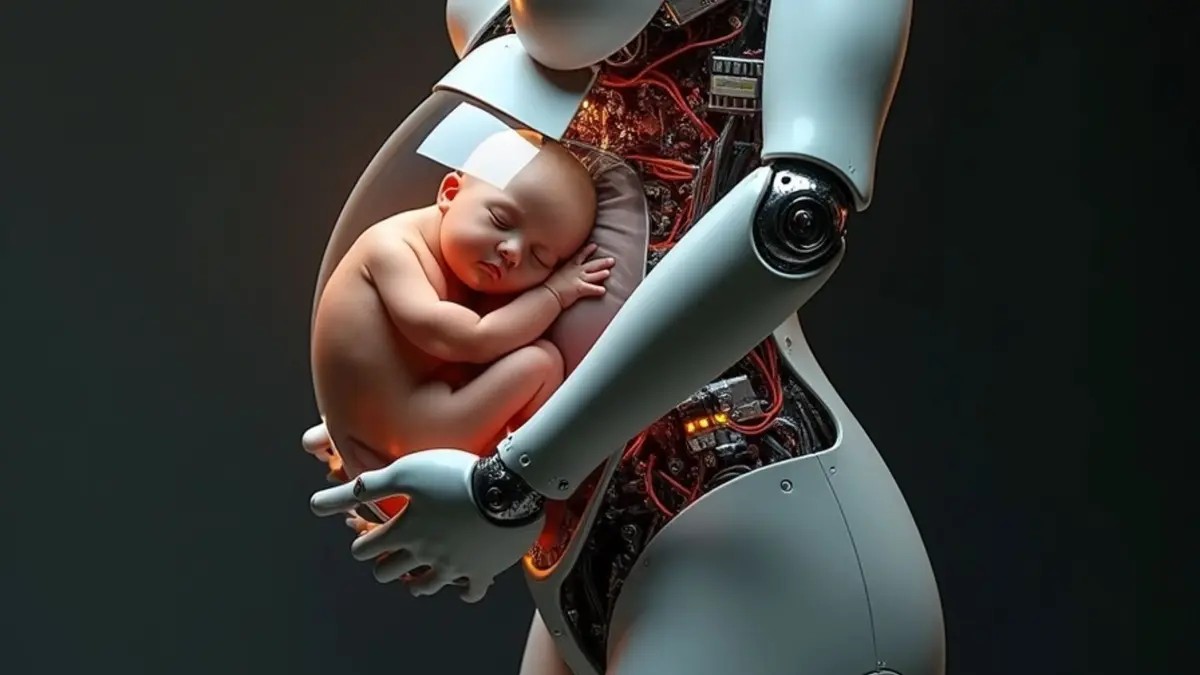
Chinese Firm Unveils Bold Plan for World’s First Pregnancy Robot with Artificial Womb
By Joseph Iyaji | Akahi News
A Chinese technology company is making headlines after announcing plans to develop what could become the world’s first “gestation robot”—a humanoid machine embedded with an artificial womb designed to carry a fetus for ten months and deliver a baby.

The futuristic concept was presented at the 2025 World Robot Conference in Beijing by Zhang Qifeng, founder of Kaiwa Technology in Guangzhou and affiliated with Nanyang Technological University. The firm hopes to launch the first prototype by 2026, with a price tag of under 100,000 yuan (approximately $13,900), according to Chinese media outlets.
A Humanoid Birth Machine
Unlike traditional incubators, which sustain life only after partial gestation, the proposed humanoid will simulate the entire process of pregnancy from conception to delivery. It will feature a life-sized robotic body with an abdomen housing an artificial womb filled with synthetic amniotic fluid.
Nutrients would be supplied through a hose, mimicking the human umbilical cord. According to Zhang, laboratory experiments have already demonstrated the maturity of artificial womb technology in animals, but integrating it into a humanoid robot will enable human–robot interaction during gestation.
“This is not just an incubator—it’s a full humanoid with the capacity to replicate pregnancy,” Zhang explained, noting that a working prototype is expected within a year.
Ethical and Legal Uncertainty
The bold project has triggered heated public debate, with reactions ranging from ethical unease to optimism for infertile couples who may see it as a revolutionary solution.
Zhang confirmed that policy discussions are ongoing in Guangdong Province, where authorities are reviewing legal proposals on artificial womb technology. However, he offered little detail on how his robot would overcome the scientific hurdles of fertilisation, implantation, and sustaining a fetus to full term—challenges that remain unsolved in human trials.
Critics argue that such technology could fundamentally alter family structures, motherhood, and human reproduction, raising questions about identity, rights, and the definition of parenthood.
A Glimpse Into Artificial Womb Research
Artificial wombs are not entirely new. In 2017, researchers at the Children’s Hospital of Philadelphia successfully grew a premature lamb—comparable to a 23-week human fetus—inside a transparent “biobag” filled with artificial amniotic fluid. Within four weeks, the lamb developed wool, showing that partial gestation outside the womb was possible.
Yet, scientists caution that moving from supporting premature life to managing full-term pregnancy requires leaps in biotechnology, bioethics, and medical safety.
China’s Broader Robotics and AI Drive
The pregnancy robot was not the only innovation showcased at the conference. Researchers also introduced GEAIR, the world’s first AI-powered breeding robot, developed by the Institute of Genetics and Developmental Biology, Chinese Academy of Sciences.
GEAIR integrates artificial intelligence and gene-editing techniques to automate cross-pollination, reduce costs, and shorten breeding cycles. Already applied to soybeans, it promises to revolutionise crop hybridisation and strengthen China’s agricultural output.
According to the research team, GEAIR creates a closed-loop intelligent breeding factory, where AI, biotechnology, and robotics converge to produce high-quality plant varieties at unprecedented speed.
Kaiwa Technology’s proposed humanoid pregnancy robot represents one of the most ambitious intersections of robotics, medicine, and reproductive science ever attempted. If successful, it could transform parenthood for those unable or unwilling to carry pregnancies.
However, the technology also raises serious ethical, scientific, and legal challenges, many of which remain unresolved. Whether China will lead the way in human artificial gestation or face global resistance will depend on the balance between innovation, regulation, and societal acceptance.
At the same time, the introduction of AI-powered breeding robots highlights China’s broader ambition to dominate the convergence of artificial intelligence, biotechnology, and robotics, reshaping both agriculture and medicine for the future.
🎓 Attend 2026 JAMB, Post-UTME, WAEC, and NECO GCE Tutorials
Get fully prepared with expert tutors, comprehensive study materials, and personalised academic guidance at Akahi Tutors.
📍 Located at 67, Oduduwa College Road, Off Sabo Junction, Ile-Ife.
📞 Call: 08038644328
for enrollment and accommodation reservation.
Akahi News http://www.akahinews.org
Leave a Reply